Building a company is often compressed into a visible sequence: have an idea, raise money, hire people and work hard.
Almost everything difficult disappears from that sentence.
A real company is built through thousands of mostly invisible acts. The founder has to understand the problem more deeply than before, talk to customers when nobody cares, fix the product again, recruit people before legitimacy exists, lose people, learn finance, sales, science, operations, regulation and storytelling, and make decisions with incomplete information every week for years.
The work is not neatly bounded. For a period, the founder carries the company around in the head. A complaint follows them home. A paper changes the product. A person met by accident becomes a recruit. A manufacturing failure returns while they are trying to sleep.
I do not think this should be romanticised. I do think it should be named honestly.
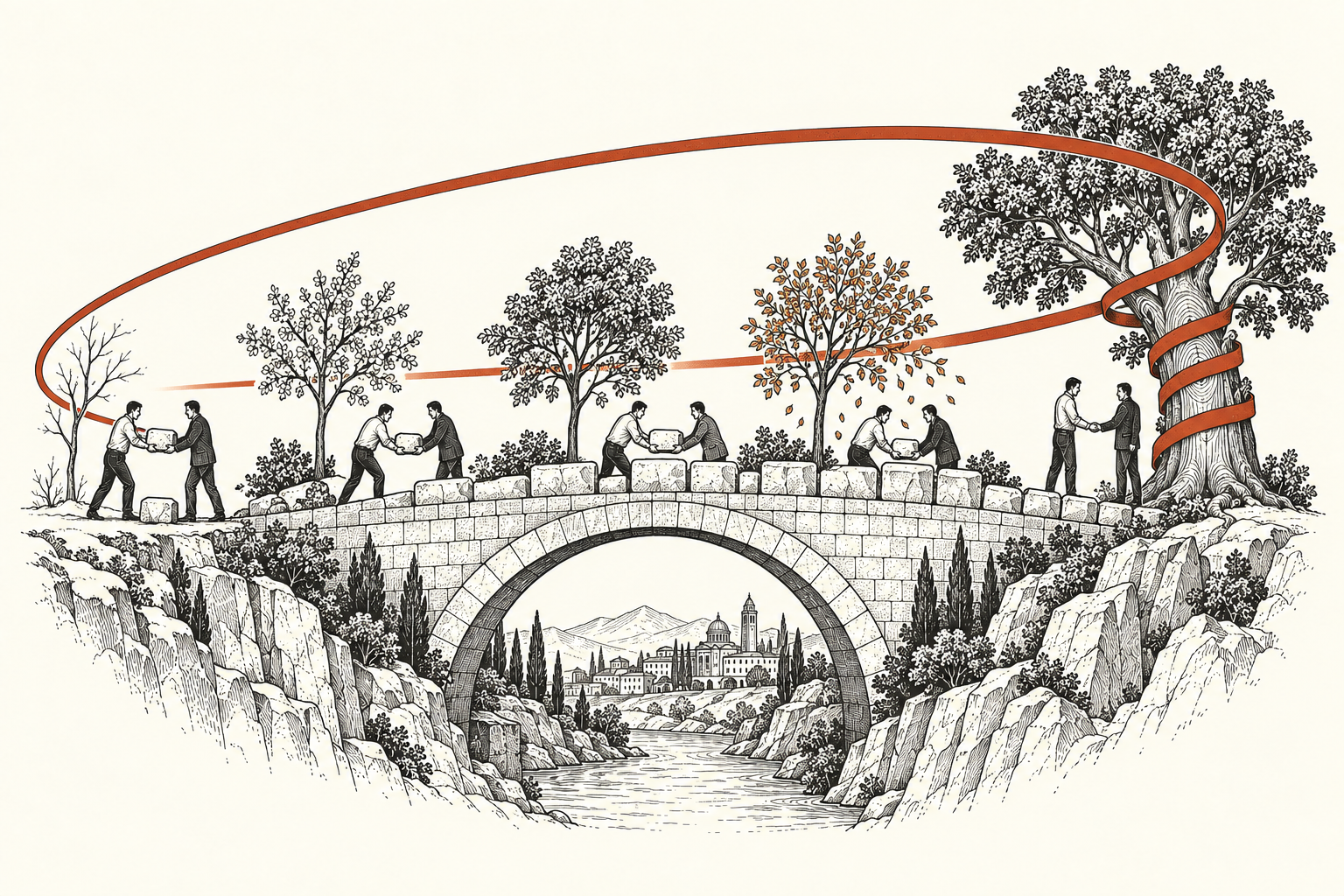
A great company is not merely a job requiring extreme hours. It is a problem somebody chooses to live with for a meaningful part of a life.
Work from love, not fear
The sentence can sound sentimental until we examine the alternatives.
Fear can produce extraordinary effort. Fear of irrelevance, failure, humiliation, poverty or being overtaken can push a person through nights that ordinary motivation would not survive. It can also narrow the field of vision. Bad news becomes a threat to identity. A colleague's talent becomes competition. A customer objection becomes disrespect. The company begins protecting the founder from reality.
Love is not softness. It is attention directed toward the thing itself.
Love for the problem means wanting the answer even when the answer proves me wrong. Love for the craft means caring about the invisible part that supports the visible promise. Love for the customer means refusing to transfer an unbounded risk merely because a contract permits it. Love for colleagues means telling the truth early enough for them to act.
Fear asks: how do I avoid looking bad?
Love asks: what does the work require?
The second question can demand more courage, not less. It may require abandoning a cherished design, admitting that a milestone slipped, replacing someone I like in a role they can no longer carry or stopping an experiment whose downside belongs to other people.
Working from love does not mean remaining in every relationship or accepting every failure. Love without boundaries becomes indulgence. It means the purpose is not self-protection.
Passion after novelty
Passion in entrepreneurship is often presented as excitement. Excitement is abundant at beginnings. It is easy to love a problem while every conversation produces a new possibility and the company has not yet been forced to choose.
Years three to seven ask for something different.
The same failure mode returns. The market takes longer than expected. A beautiful prototype becomes a tedious qualification programme. A customer changes personnel. A senior hire does not work. The founder has to learn a part of the business that does not flatter their identity.
Passion at this stage is closer to:
I care about this enough to remain with the problem after novelty stops paying me.
Katalin Karikó's work on messenger RNA is a useful example, provided we resist turning it into a fairy tale of one heroic scientist. The eventual success of mRNA vaccines depended on decades of work across modified nucleosides, lipid nanoparticles, manufacturing, clinical development and institutions. Karikó's persistence matters not because every rejected grant or difficult year was secretly destined to succeed. It matters because she stayed close enough to a real technical obstacle to keep producing better questions while the surrounding system repeatedly valued other work more highly.
The lesson is not “ignore everyone and persist forever.” Many ideas deserve to die. The lesson is that sustained attention can create distinctions unavailable to a visitor. Caring about one problem long enough can make a person unusually good at seeing it.
Intelligent attempts, not the performance of confidence
People often forgive awkward experiments, failed products and strange ideas when they can see that the attempts serve something real and that the person is learning.
One genuinely good thing can reframe what came before. An important paper can make years of odd questions look like preparation. One product can change the story of a company. A breakthrough can travel far beyond the small audience that saw the earlier failures.
There is a useful asymmetry here: failure is usually local; a breakthrough can be reputationally global.
But this cannot become an excuse for repeated carelessness. Survivorship bias turns every mistake made by a successful person into a necessary chapter of genius. Some attempts were waste. Some behaviours were harmful. Success may have arrived despite them.
The right objective is not to maximise the number of failures. It is to maximise the number of intelligent attempts the system can survive.
An intelligent attempt states what is being tested, chooses a result capable of changing the decision, records the conditions, preserves inconvenient evidence and changes the next action. Even when it fails, it reduces uncertainty.
A careless attempt has no threshold, changes the explanation after the outcome and repeats itself with a new story.
The game becomes less “How do I avoid looking ridiculous?” and more “How many serious attempts can I make while improving fast enough that something may become undeniable?”
The repeated game
The Veritasium discussion of game theory is useful because it shows why goodness and strategy need not be enemies.
In a one-shot Prisoner's Dilemma, betrayal can look rational. In repeated games, today's action changes tomorrow's opponent, information and opportunity. Reputation enters the payoff. A strategy such as Tit for Tat begins cooperatively, responds to defection and remains legible. Under noise, strict retaliation can trap both sides, so a degree of forgiveness can improve the long-run result.
Company-building is full of repeated games.
Founders return to the same technical communities, supplier networks, customers, regulators and specialised talent pools. An investor remembers whether bad news arrived with the data or after the next round. An engineer remembers whether raising a safety concern protected the product or damaged their career. A buyer remembers whether a missed specification was disclosed early.
Naval Ravikant's advice to play long-term games with long-term people gives the principle a human form. Trust compounds. Shared context reduces coordination cost. Accurate bad news can make the next conversation easier, not harder.
But “be nice” is an incomplete translation of repeated games. A good long-term strategy needs boundaries.
• Offer cooperation before demanding submission.
• Make promises and evidence standards clear.
• Respond when trust is violated.
• Distinguish a correctable mistake from an exploitative pattern.
• Permit repair after honest accountability.
• Leave relationships that repeatedly make truth unsafe.
Fear defects early so it cannot be exploited. Naïveté cooperates without learning. Mature trust begins open, observes behaviour, protects the work and updates.
Integrity is an operating system
Integrity is often described as a personal virtue. In a serious company it has to become an operating system.
Toyota's andon practice is powerful because it changes who is allowed to reveal a problem. A worker can signal that something is wrong and stop the process before the defect disappears into the next stage. The system makes interruption costly in the short term because hiding the problem would be more costly later.
The Challenger disaster shows the inverse. The Rogers Commission record describes concerns around the solid rocket booster joints and the decision process preceding launch. The lesson is not that one evil person ignored one obvious fact. It is that technical uncertainty, schedule pressure, organisational authority and communication can combine until evidence loses force while still travelling through the organisation.
This is why telling people to “speak up” is inadequate. The company must ask what happens after somebody speaks.
Can a junior engineer stop a test? Does a commercial leader lose status for revising a claim downward? Does the person who set the deadline remain present when quality pays the cost? Are failure criteria written before the result? Can caveats survive the journey from laboratory to board deck to customer proposal?
Integrity exists when truth can change the decision.
It also lives in invisible details. Jobs used the image of a carpenter finishing the back of a chest of drawers even though the customer would not normally see it. The point is not limitless perfection. It is that the visible promise should be supported by the unseen construction.
Care establishes the standard. Process makes the standard repeatable.
High standards without cruelty
Founders sometimes inherit a damaging mythology from famous builders: the product was great because the leader was brutal, therefore brutality is the price of greatness.
That is poor causal reasoning.
An exacting standard can improve work. Fast feedback can prevent months of drift. A leader may need to say that something is not good enough when everybody has already worked hard. None of this requires humiliation, manufactured fear or the destruction of a person's ability to contribute.
Pixar's Braintrust offers a better distinction. The work can be exposed to severe criticism while the director retains authorship. The group attacks the weakness of the film; it does not need to convert criticism into dominance over the person.
The useful line is between pressure on the idea and damage to the contributor.
High standards should increase the resolution with which a team sees the work. Cruelty reduces resolution because people begin optimising what they reveal.
The strongest culture is not one in which nobody is uncomfortable. It is one in which discomfort is attached to reality, not the leader's mood.
Avoid ruin
The freedom to attempt depends on surviving the attempt.
Nassim Nicholas Taleb's work on convexity and ruin provides an essential correction to casual advice about failing fast. Experimentation is powerful when the downside of each attempt is limited and the possible gain is much larger. Many trials can fail cheaply while one discovery produces an outsized benefit.
The principle breaks when failure is absorbing.
If an experiment costs a week, produces clean information and leaves the company able to try again, failure can be an input. If it harms a patient, destroys the only qualification relationship, creates an irreversible environmental release or consumes the remaining runway without testing a decisive assumption, the same language becomes reckless.
A company taking a small probability of extinction again and again is not courageous merely because it survived the first few rounds.
The serious design problem is to make experiments bold in information and bounded in downside.
This matters beyond the company. A firm can survive while exporting ruin to patients, employees, customers or the public. Skin in the game means that the person making a consequential decision should not keep the upside while sending the downside elsewhere.
Equity ownership is not enough. Warranties, milestone payments, acceptance tests, incident reporting and responsibility for field outcomes can connect claims to consequences more directly.
Survival is not timidity. It is the condition that permits learning to compound.
A routine is not the work
There is an entire category of books that converts the visible habits of successful people into causes: wake at five, make the bed, take the cold shower, copy the morning pages, adopt the founder's calendar.
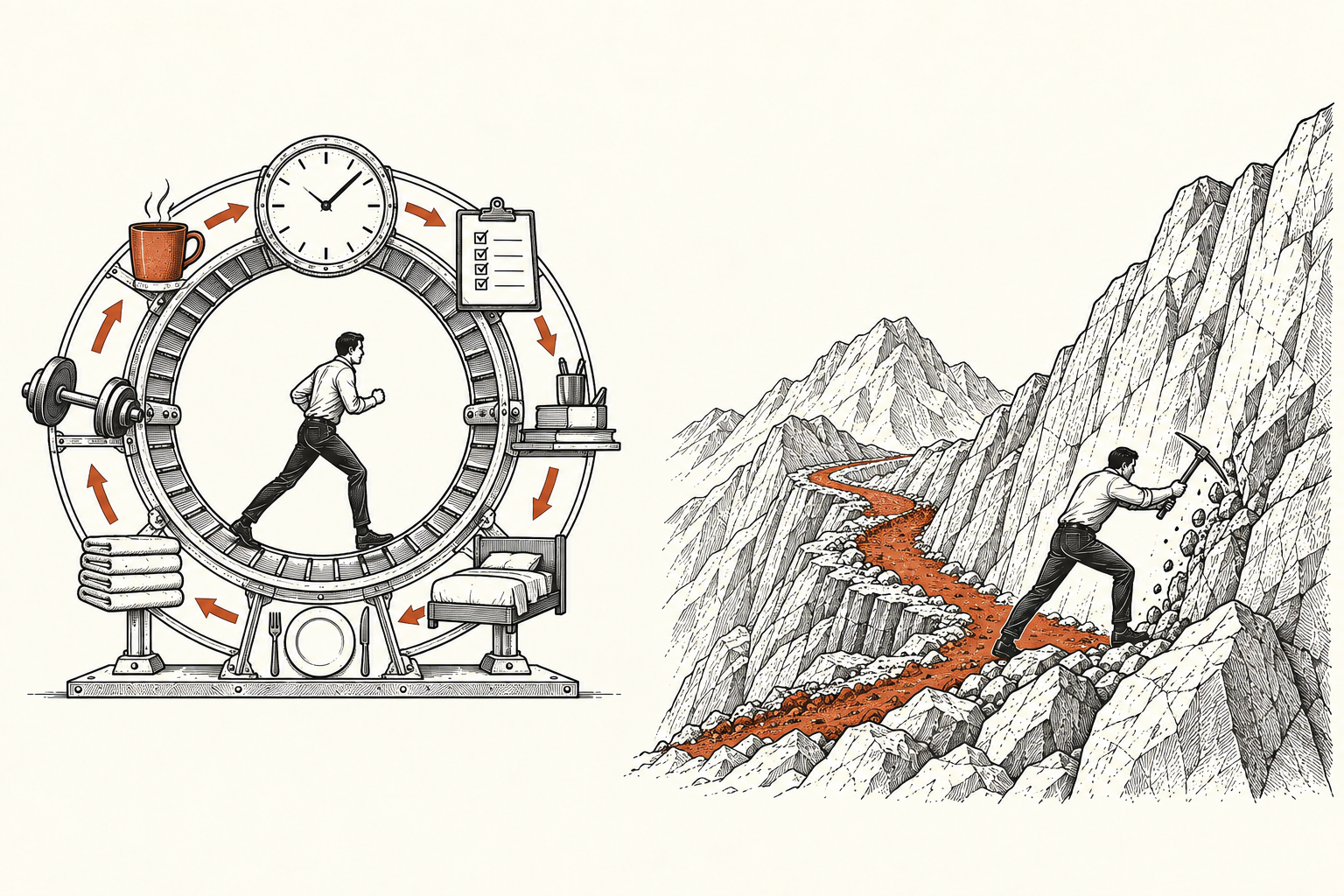
Some routines are useful. Sleep, exercise, reflection and uninterrupted time can support judgment. The error is confusing the support system with the work.
The work is sustained attention to a consequential problem. It is the decision made when evidence is incomplete, the conversation nobody wants, the experiment designed well enough to be allowed to fail, the customer visited for the fortieth time and the detail repaired after novelty is gone.
A person can perform every ritual of seriousness while avoiding the thing that might prove them wrong.
I would rather ask:
• What problem have I chosen to remain answerable to?
• What can I see now that I could not see a year ago?
• Which prediction did I revisit?
• What responsibility have I learned to carry?
• Which part of the work still depends on performance rather than competence?
The routine should serve the work. The work cannot be replaced by a routine.
Let life feed the company
Carrying a problem does not require reducing life to the company.
Sleep, health, relationships, reading, art, travel and periods away from the immediate task are not automatically distractions. They can widen the set of distinctions from which judgment is made. Jobs's understanding of Apple did not come only from studying computers. Typography, music, industrial design, architecture, history and human behaviour supplied ways of seeing what a computer could be for.
The lesson is not to collect interests for their future commercial use. It is to live widely enough that the company does not become a closed intellectual system.
Breadth supplies possible connections. Responsibility tests whether those connections are any good.
The company can consume a large part of a life for a period. Life must also be allowed to feed the company.
The institution is also a product
The founder cannot remain the only carrier of love, judgment and integrity.
If the organisation tells the truth only when the founder is in the room, it has no integrity system. If the quality standard disappears during delegation, it has taste but not capability. If every difficult customer decision returns to one person, the company has not built an institution; it has built a queue.
The deeper act of company-building is converting personal conviction into shared practice without draining it of meaning.
That requires people, incentives, processes and decision rights. It requires remembering why a standard exists while allowing its implementation to improve. It requires a culture capable of disagreement without becoming directionless.
The founder's final product is not the original invention. It is an organisation that can keep making responsible promises after the founder stops making every decision.
What I currently believe
I am still working out how to hold ambition and gentleness, urgency and patience, conviction and updateability at the same time.
I do not think the answer is moderation in everything. Some moments demand obsession. Some standards deserve refusal. Some opportunities close if a team moves slowly.
The answer is to know what the intensity serves.
Love gives the work a reason beyond self-protection. Integrity prevents the reason from becoming an excuse. Hard work carries the idea through the details. Boundaries keep hard work from turning into ruin. Repeated games make trust economically consequential. Life beyond the company keeps the mind from becoming smaller than the problem.
The long game is not simply staying in the game.
It is becoming more capable, more truthful and more useful while you remain.
Questions I now ask
1. Am I protecting the work or protecting my identity as the person who was right?
2. What will still matter after the novelty disappears?
3. Did the last failed attempt reduce uncertainty and change the next action?
4. Can bad news change a decision inside this company?
5. Are standards producing better work or merely more fear?
6. What consequence returns to the person who made the decision?
7. Is the next experiment information-rich and bounded in downside?
8. Where does the company face risk of ruin?
9. Which routine supports the work, and which routine is helping me avoid it?
10. Is the organisation becoming more capable when the founder is absent?
Philosophy is only valuable if it survives contact with company design.
The next question is therefore structural: where inside the new architecture should the company sit?