The first three chapters are about value, scarcity and power. They ask why people pay, where an advantage begins and why an incumbent system can remain standing even when a better component appears.
But a book that teaches us to see power without asking what power is for would be incomplete. It could become a more sophisticated manual for extracting the largest possible share from everyone around us.
I know why that language is seductive. Moats, leverage, control points and value capture make the world look legible. They are useful ideas. A company that captures none of the value it creates cannot continue its work. Yet I do not want capture to become the purpose of the work.
My present belief is this:
The best technology increases the capability of people and institutions. The best company captures enough value to keep building while enlarging the amount of value available to everyone else.
The point is not to protect my slice of the pie. The point is to make a larger pie possible.
This is not charity. It is a theory of progress and, I think, a better theory of durable company-building.
Capability is the point
Steve Jobs used the image of a bicycle for the mind. A bicycle does not replace the rider. It joins the rider and changes what the same body can do with the same time and energy.
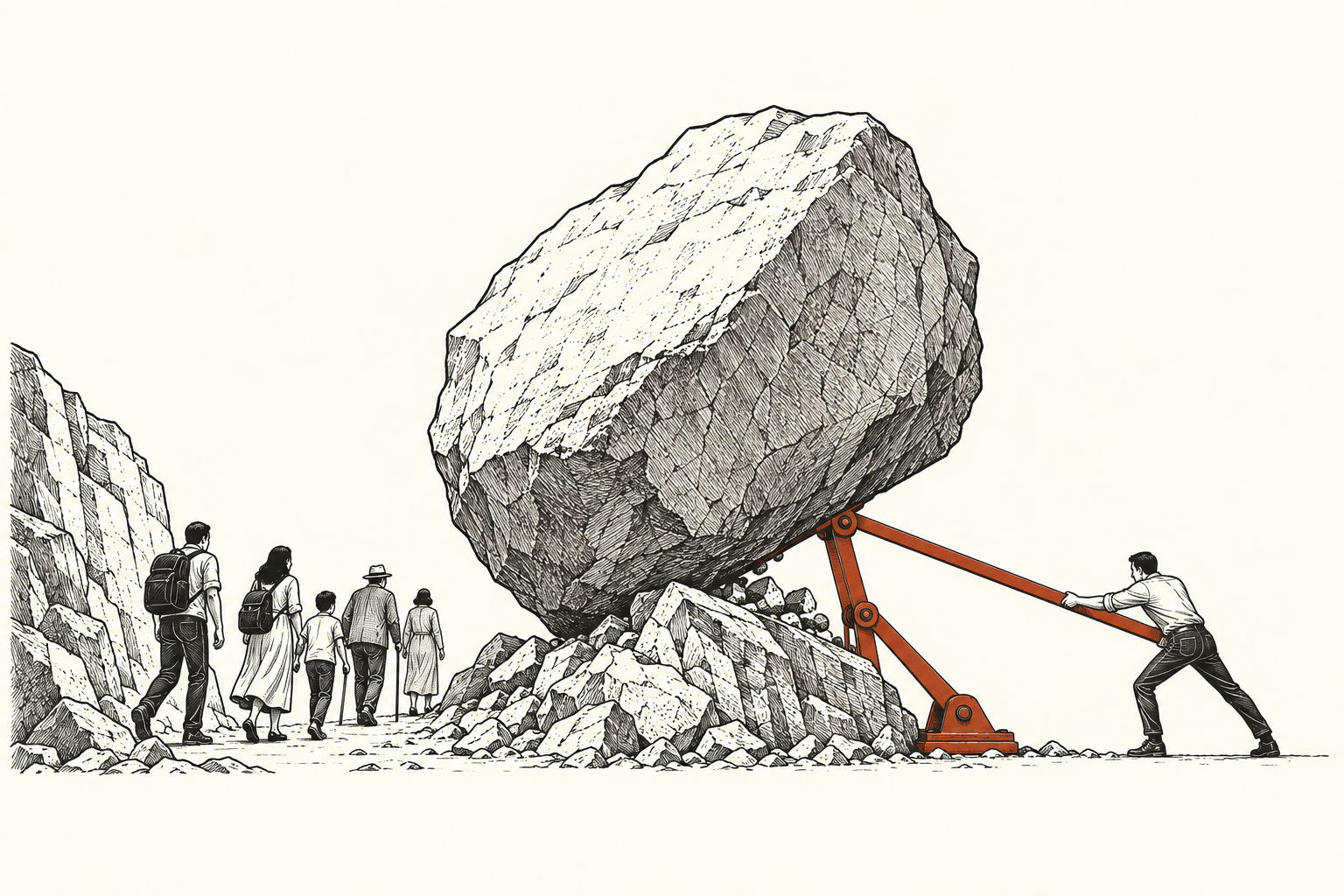
The useful unit is therefore not the tool. It is the person-plus-tool system.
Does the combined system let a scientist run an experiment she could not previously afford? Does it let a factory worker detect a failure before it becomes dangerous? Does it let a small manufacturer meet a standard that once required the resources of a much larger company? Does it give a patient more agency, an engineer better judgment or a founder a shorter route from question to evidence?
A technically extraordinary product can create little capability if it is too difficult to use, too unreliable to trust or too expensive to deploy. A modest-looking product can create enormous capability if it removes the one constraint that kept an important action out of reach.
This is why I increasingly distrust product descriptions made only of nouns: model, robot, molecule, satellite, platform. I want to know the new verb the product gives somebody. What can that person or institution now do?
OpenAI and the distribution of cognitive capability
What interests me about OpenAI is not only the intelligence of its models. It is the capability those models place in other people's hands.
A person who cannot afford a research team can interrogate a difficult subject. A small company can prototype software, analyse a dataset, translate technical material and create first versions of work that once required several specialists. A student can ask follow-up questions without being embarrassed by what they do not know. An expert can move faster across the parts of a problem that are necessary but not their deepest craft.
The important change is not that the machine performs a task in isolation. It is that the frontier of what a person or small team can attempt moves outward.
This does not settle the difficult questions. A system can be wrong with great fluency. Access can remain unequal. Skills can atrophy when assistance becomes substitution. Powerful infrastructure can concentrate control even while it distributes capability. A tool that expands agency in one direction may create dependence in another.
Those tensions are exactly why purpose matters. The relevant measure is not the number of tasks automated or the amount of output produced. It is whether more people can understand, create and act—and whether they retain enough judgment to know when the tool should not be trusted.
The deepest form of technological progress is not the replacement of human agency. It is an expansion of the frontier of who gets to exercise it.
TSMC and the distribution of industrial capability
The same principle can operate at the level of companies.
Before the pure-play foundry model matured, building an important semiconductor company often meant carrying the burden of fabrication as well as design. A new firm needed not only an idea for a chip but access to one of the most capital-intensive and exacting manufacturing systems in the world.
TSMC changed the division of labour. By committing itself to manufacturing chips designed by customers rather than competing with those customers in end products, it helped make a different kind of company possible: the fabless semiconductor firm.
TSMC did not make advanced fabrication simple. It made the capability accessible through a trusted institutional boundary. Design companies could concentrate more of their capital and attention on architecture, software and markets while relying on a manufacturing partner whose process learning compounded across customers.
That is a profound form of capability creation. One company's difficult competence increased the number and variety of other companies that could exist.
There is an important warning inside the success. When many companies depend on one scarce industrial capability, the enabler gains enormous power and the system gains a concentration risk. Increasing capability does not eliminate politics, bargaining or fragility. It changes where they sit.
Still, the generative effect is clear. A great enabling company is not merely a tollbooth. It is infrastructure upon which other serious attempts become possible.
NASA COTS and the distribution of ecosystem capability
Capability can also be created by the design of a programme.
NASA's Commercial Orbital Transportation Services programme did not simply buy a finished commodity or prescribe every design choice to a contractor. It used funded milestones and a demanding mission to help private companies develop cargo transportation capability for the International Space Station. NASA brought technical knowledge, a real customer need and an acceptance standard. The companies had to build vehicles and operating systems capable of satisfying it.
SpaceX is the most visible outcome, but the more interesting lesson is institutional. A public agency can either keep capability inside a traditional contracting architecture or help create suppliers able to carry more technical and commercial responsibility themselves.
The programme did not remove risk. It organised risk around evidence. Capital followed milestones. The customer was real. The test was not whether a slide deck sounded visionary but whether a vehicle could perform.
The result was larger than a procurement transaction. It helped create ecosystem capability: new operating knowledge, new infrastructure, new suppliers and a stronger path for later missions.
This gives me three levels at which technology and company design can enlarge the pie:
1. A tool can increase the capability of an individual or small team.
2. An enabling company can increase the capability of other companies.
3. An institution or programme can increase the capability of an ecosystem.
OpenAI, TSMC and NASA COTS are not morally or economically identical. I place them together because each asks the same generative question: how many more consequential things can other people now attempt?
Change the denominator to human life
One story from the Macintosh team has stayed with me. When Jobs pushed to reduce startup time, he reframed a few seconds of delay across millions of users as a large quantity of human life. The arithmetic was a motivational analogy, not a literal medical claim. Its power came from changing the denominator.
The delay was no longer merely a computer-performance metric. It became time taken from people.
Deeptech often hides human consequence behind technical language. A two-per-cent improvement in yield sounds small until it is measured against the material, energy and working capital consumed by an industry. A sensor that reduces false alarms by a few points sounds incremental until we count operator fatigue, unnecessary shutdowns and real emergencies missed. A diagnostic that removes one hospital visit sounds modest until we count travel, lost wages, anxiety and delayed treatment across a population.
Changing the denominator does not permit us to manipulate the numbers. It forces us to choose the unit that reveals the decision.
Whenever a founder says the product increases capability, I want to know for whom, measured how and at what cost elsewhere. Automation may improve throughput while making the remaining work more dangerous. A convenient interface may remove a user's ability to understand or contest an important decision. A cheaper process may export an environmental cost beyond the balance sheet.
Capability is not a slogan. It is an accounting problem with a longer boundary.
Make the possibility legible
Creating a capability is not enough if people cannot understand what it permits them to do.
Apple's early stores were organised around activities and demonstrations, not only shelves of machines. That was a distribution decision, but it was also a translation decision. An unfamiliar capability becomes easier to choose when a person can see a complete activity performed and imagine themselves performing it.
Airbnb's early history offers the opposite route to the same truth. Before the company could scale trust through software and systems, the founders went close to the experience. They met hosts, photographed homes and examined the journey in detail. Brian Chesky's later exercise of imagining an “eleven-star experience” was deliberately exaggerated, but its purpose was practical: begin with a human outcome vivid enough to feel, then work backwards toward the system that could deliver a feasible version of it.
Both examples resist a lazy separation in which product creates value and distribution merely advertises it.
In unfamiliar markets, distribution has to teach, demonstrate, reassure and translate. A company has not fully delivered a capability until the intended user can recognise it, trust it and put it to work.
Build people, not only products
If the purpose is to increase capability, the principle has to apply inside the company.
A weak organisation uses talented people as temporary energy sources. The founder remains the only person allowed to make the important judgment, and everybody else learns to wait for an answer. The company may move quickly for a while, but it is not compounding. Its people become more dependent as the founder becomes more overloaded.
A strong organisation increases the quality of judgment around it. Engineers understand the customer consequence. Product leaders understand the technical constraint. Commercial teams learn what the evidence can and cannot support. Younger people receive responsibility with feedback, not only tasks.
This does not mean everyone votes on every decision. Some choices need a clear owner. It means authority is used to build further authority rather than to preserve the leader's uniqueness.
Edwin Land's appeal to Jobs was not only that he invented products. He built an institution in which science, art and business could work together repeatedly. Pixar's Braintrust was powerful not because a room full of people magically agreed, but because candid criticism could improve a film without transferring authorship away from the director.
The higher-order product is the organisation's ability to keep producing worthwhile work.
Increase the pie
The language of strategy often trains us to see every relationship as a contest over a fixed quantity of value.
Sometimes it is. Price negotiations, ownership and bargaining power matter. A founder who ignores them may build a valuable technology and lose the company. A supplier who never understands capture can become indispensable and remain poor.
But the most consequential companies often create a larger game before they negotiate their share.
TSMC enabled more chip companies. A useful AI system lets more people attempt knowledge work. A platform can make a market accessible to smaller producers. A diagnostic can make early treatment economical. A manufacturing tool can let a new material reach applications its inventor could not serve alone.
This is a different ambition from altruistic self-erasure. The enabling company should capture value. Without capture, it cannot invest in reliability, talent and the next capability. The question is whether its power depends mainly on making others weaker or on making the surrounding system more productive.
I would rather build the company whose customers become more capable as the company becomes stronger.
The boundary capability without captivity
Civilisation is organised interdependence. I depend on electricity, medicine, transport and tools I could never reproduce alone. Dependence is not automatically exploitation.
The boundary is whether the company uses a difficult capability to deliver a dependable outcome or deliberately manufactures helplessness to preserve control.
Lock-in can sometimes protect a system that requires coordination, safety or continuing investment. It can also be used to prevent a customer from leaving after the value has been delivered. An integrated product can remove burden. It can also remove agency. A model can teach. It can also become an oracle that nobody inside the customer's organisation knows how to challenge.
I now ask a question that is uncomfortable because it applies equally to products I admire:
After using this product, is the customer more capable—or merely more captive?
The answer may contain both. The responsibility is to know the difference and to design deliberately.
What I am trying to practise
I do not always live up to the standard in this chapter. It is easier to admire scale than to ask what the scale enables. It is easier to praise a moat than to examine whether it is built from accumulated competence or artificial dependence. It is easier to talk about impact than to name the person whose capability actually changed.
The discipline I want is more concrete:
• Begin with the human or institutional capability, not the artefact.
• Name the new action the product makes possible.
• Count burdens that have merely moved to somebody else.
• Capture enough value to continue the work.
• Prefer advantages that make customers and partners stronger.
• Use authority to create more capable people and institutions.
• Measure progress by the serious attempts the system enables, not only the activity it automates.
The purpose of power is not to remain powerful.
It is to make more of the world capable of acting.
Questions I now ask
1. What can a person or institution do after this product that they could not do before?
2. Is the product expanding judgment or replacing it without accountability?
3. Which capability remains inaccessible because of cost, complexity, trust or distribution?
4. Does the company remove complexity or merely transfer it to less visible people?
5. Does the business become stronger by making the customer stronger?
6. What does the enabling layer allow other companies to build?
7. Could a programme or institution organise risk so an ecosystem learns faster?
8. What is the correct denominator for the value created?
9. Who bears the cost excluded from that denominator?
10. After adoption, is the customer more capable or more captive?
A philosophy of capability tells us what company power should serve. It does not tell us how to remain with a difficult problem long enough to earn that power without losing ourselves or betraying the people around us.
That is the question of the long game.