I kept returning to a question that sounded almost too basic to be useful:
What is the price of a thing?
My first answer was perceived value. Something is worth what somebody believes it is worth.
That seemed to explain why two functionally similar products could sell for very different amounts. Brand mattered. Scarcity mattered. Supply and demand mattered. Trust, status, timing and distribution mattered. Price was not sitting invisibly inside the object, waiting to be discovered.
I still think this is directionally right. I no longer think it is precise enough.
Perceived value, willingness to pay, price and value captured are related. They are not the same.
A buyer can value an outcome enormously and pay very little if many suppliers can deliver it. A scarce product can have no meaningful price if nobody wants the result. A supplier can create most of the value and capture little because another company controls distribution or the customer relationship. A buyer may be willing to pay but unable to use the relevant budget. Regulation can fix a price. Procurement can compress it. Urgency can expand it.
The object is only one part of the transaction.
A more useful starting point is:
Price is the portion of expected value a seller can capture under conditions shaped by confidence, alternatives, scarcity and bargaining power.
To understand the price, I first need to understand what change the buyer is trying to purchase.
People buy state changes
People rarely want products in the abstract. They want to move from one state to another.
From sick to well.
From exposed to protected.
From a design to a manufactured part.
From uncertain to informed.
From stranded to transported.
From unreliable power to dependable power.
From scientific question to validated answer.
The product is the vehicle through which the change becomes possible.
This sounds obvious after a company has compressed the work. A payment product turns “I want to sell” into “I got paid.” A manufacturing platform turns a specification into a delivered component. A diagnostic turns a sample into a decision. A storage system turns variable generation into usable power.
Before the product exists, the customer may have to assemble the outcome from many pieces. They find suppliers, integrate tools, manage failure, finance equipment, coordinate experts and carry the uncertainty between them.
The strongest product absorbs enough of that complexity to return a coherent result.
This is more than convenience. It changes what the buyer is willing to attempt.
Expected value is not the headline benefit
A buyer values an outcome through uncertainty.
Change an assumption
Trust changes expected buyer value
A numerical version of the chapter’s mental model. Costs are already expressed as expected costs, and the benefit is conditional on delivery. Units are hypothetical; this does not calculate a selling price.
Expected buyer value = delivery probability × outcome benefit − adoption and expected failure costs.
Source: editable illustrative assumptions and the displayed formula, designed 28 September 2026. This is a scenario, not observed performance or a forecast. All plotted values are calculated from the current inputs.
A simple mental model is:
The economics of trust
- Expected buyer value
- Probability of dependable delivery
- Value of the outcome
- Cost of adoption
- Expected cost of failure
A mental model, not a precise pricing formula. Confidence changes what the same outcome is worth to a buyer.
This is not intended as a precise pricing formula. It separates three questions that are easily confused.
First, how valuable is the desired state change if achieved?
Second, how confident is the buyer that this product and supplier can produce it?
Third, what must the buyer spend, risk or reorganise to adopt it?
A product can promise an extraordinary outcome and still produce low expected value if the probability of dependable delivery is small. A modest improvement can be valuable if it arrives with high confidence and almost no adoption burden. The cost of failure may dominate both.
For an individual consumer, failure may mean wasted money or inconvenience. For a factory, hospital, defence operator or energy system, failure can mean downtime, liability, injury or loss of a mission. The same claimed benefit produces different willingness to pay because the boundary conditions differ.
This is why technical performance alone rarely explains price.
Trust changes the economics
Trust can sound soft beside engineering specifications. In high-consequence markets, it is an economic variable.
Suppose a system could save a buyer one hundred units if it works. If the buyer assigns only a 20 per cent chance that it will perform reliably, the expected benefit begins near twenty units before integration and failure costs. If accepted field evidence raises confidence to 80 per cent, the expected benefit begins near eighty.
The underlying promise may be unchanged. The product's economic meaning has changed.
Brand can perform a similar function in consumer markets. It can reduce uncertainty about quality, signal identity or make a choice socially legible. Qualification, field history, warranties, references and service perform versions of that function in industrial markets.
Trust is not merely persuasion layered on top of value. It changes the buyer's estimate of whether value will arrive.
That is why evidence accumulated after invention can become more defensible than the invention looks on its own.
Adoption has a hidden price
The quoted price is not the buyer's full cost.
Adoption may require:
• Installation and integration.
• New training and workflows.
• Qualification or regulatory work.
• Downtime during changeover.
• Replacement of compatible equipment.
• New maintenance and spare-parts systems.
• Political or career risk for the person choosing the supplier.
• Financing and working capital.
• The loss of a familiar fallback.
A startup often compares the performance of its product with the performance of the incumbent. The buyer compares the total consequence of staying with the total consequence of changing.
This difference explains why “better and cheaper” can fail to move a market. The improvement may be real and still too small to overcome the surrounding burden.
The product therefore includes more than the core technology. It includes everything required to make the promised state change believable and adoptable.
Absorb complexity without hiding risk
I am drawn to companies that take a fundamental intention, absorb the necessary complexity and return a simple outcome.
The buyer does not necessarily want a collection of components, vendors and interfaces. The buyer wants the result.
Zepto is a useful consumer example. The customer does not want to study a neighbourhood inventory network, procurement schedules, picker productivity, routing logic and payment operations. The customer wants groceries to appear quickly. The interface compresses an industrial system into a request. The apparent simplicity is valuable precisely because the company carries so much coordination behind it.
But simplicity at the interface can conceal complexity inside the company. A product can feel effortless to the customer because the startup is performing expensive custom work, carrying every asset, accepting unlimited liability or depending on founders to rescue each deployment.
That is not durable compression. It is displaced complexity.
The company needs to absorb the parts that create a coherent promise while standardising, pricing, partnering or exposing the parts it cannot sustainably carry.
This introduces a distinction that will matter throughout the book:
The company does not have to own every operation. It has to control the elements that determine the outcome, preserve learning and protect value capture.
An energy company may not manufacture every component. A biotechnology company may use a contract manufacturer. A semiconductor company may not own a fabrication plant. A robotics company may rely on integrators.
The strategic question is whether these relationships allow the company to deliver the result and retain the evidence, interface or knowledge through which it becomes more capable over time.
Value created is not value captured
Even when a product creates substantial value, price depends on the alternatives available to both sides.
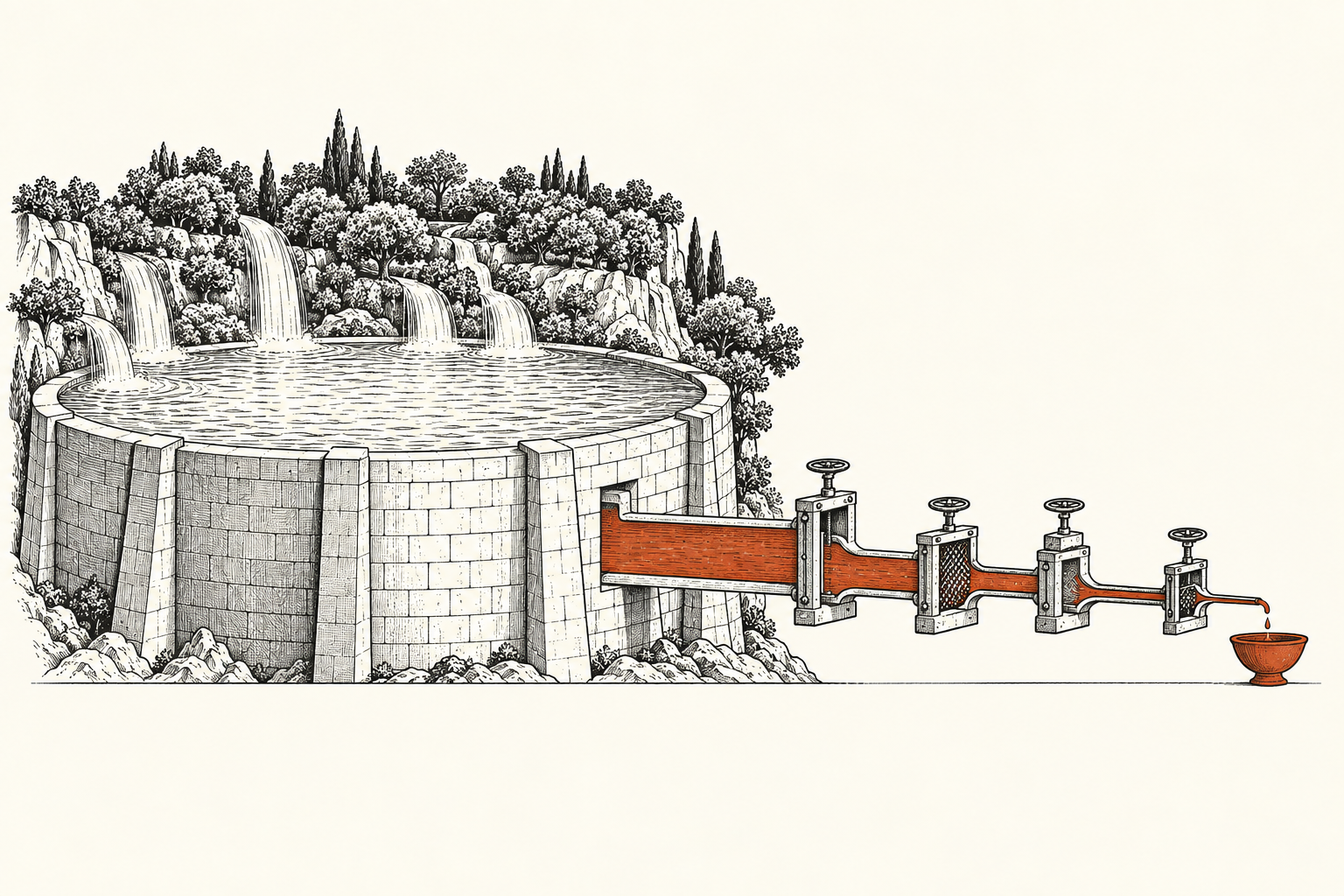
If many suppliers can produce the outcome, competition may transfer most of the value to the buyer. If one supplier controls a scarce capability, qualification, interface or distribution channel, it may capture more. If the buyer is the only credible customer, the buyer may hold the bargaining power. If switching costs are high after adoption, the balance can change.
The company therefore has to ask two different questions:
1. How much value does the product create?
2. What allows this company to retain a meaningful portion of it?
The first question is about the outcome.
The second is about position.
A technically central component can create enormous system value and remain a low-margin input. A product that appears peripheral can capture more because it owns the customer relationship, standard or critical bottleneck.
This is why market size alone tells me so little about company value. A startup does not receive a percentage of a market because its technology participates in the system. It captures value through a position the system cannot easily route around.
Perception can be wrong in both directions
Calling value “perceived” does not mean perception is arbitrary.
The buyer can overestimate a product because the story is compelling and evidence is weak. The buyer can also underestimate a product because the consequence is difficult to imagine, the proof is unfamiliar or the benefit appears in another budget.
Companies act on this gap in two ways.
Some change perception: they make the outcome legible, earn trust, reduce psychological friction and reach the customer at the right moment.
Others change reality: they improve performance, reliability, cost or access so substantially that the old perception can no longer hold.
Most enduring companies do both.
The danger is believing that one can permanently substitute for the other. Narrative cannot rescue a product that repeatedly fails. Technical superiority cannot capture value from a market that does not understand, trust or adopt it.
The two forces meet in price.
What each new piece of evidence should change
This book began because very different signals were being treated as interchangeable progress.
A funding round tells me that somebody supplied capital. It may not tell me which technical risk was removed.
A prototype tells me that something worked under stated conditions. It may not tell me whether it works in the buyer's environment.
A pilot tells me that a customer was willing to try. It may not establish qualification or repeat demand.
An order tells me more than a memorandum. It may still leave delivery, acceptance, margin and repeatability unresolved.
Each signal should change a particular part of expected value. It might increase confidence in delivery, reduce adoption burden, reveal demand, strengthen scarcity or alter bargaining power.
If I cannot say which variable changed, I should be careful about claiming that the company became more valuable.
This principle is simple, but it reorganises the market. Evidence has meaning only in relation to a claim, a buyer and a decision.
Questions I now ask
1. What state change does the buyer actually want?
2. How valuable is that outcome if achieved?
3. How confident is the buyer that this product and supplier can deliver it?
4. What does adoption cost beyond the quoted price?
5. What happens if the product fails?
6. What complexity does the product absorb for the buyer?
7. Has the company removed complexity or merely moved it onto its own balance sheet?
8. What alternatives does each side possess?
9. Which scarce position allows the company to capture value?
10. What specific part of expected value did the latest evidence change?
Price begins with a desired state change. It is shaped by confidence that the outcome will arrive, the burden of adopting it and the relative power of buyer and seller.
The next question sits underneath all three.
What must the company make scarce?
Sometimes it must make a human choose. Sometimes it must make reality yield. Often, it must build the bridge between them.