I once wanted to put consumer companies and software companies in one bucket, and deeptech companies in another.
The first group seemed to play a perceived-value game. The product could usually be built; the real contest was for attention, trust, habit, distribution and willingness to pay. Deeptech seemed different. Before anybody could choose the product, the company had to make something technically difficult become possible.
There was something useful in that distinction. There was also something wrong with it.
All businesses play a perceived-value game. A buyer always has to understand and trust the expected outcome. Every company needs distribution. Every company eventually has to make a human or institution choose.
And software is not one thing. A social application, semiconductor-design tool and control system for critical infrastructure do not face the same uncertainty merely because all three contain code. A consumer product can depend on difficult science. A hardware company can fail because it never learns to sell.
The boundary is not software versus atoms.
It is where the dominant uncertainty sits.
The frontier of nature
The first frontier is our ability to make reality yield.
Can a molecule reach the relevant cell without unacceptable toxicity?
Can a battery survive the required cycles?
Can a material maintain its properties under heat, load and time?
Can a manufacturing process reach the necessary yield?
Can a navigation system continue operating when the expected signals disappear?
Can a model, instrument or machine perform at the accuracy and reliability the use case requires?
These are capability questions. Nature does not negotiate with the narrative. The result works under the required conditions or it does not.
This does not make the answer permanently binary. Performance exists on a curve. An experiment can work once and fail when scaled. A system can meet one use case and miss another. Economics can make a physically possible process commercially irrelevant.
But reality imposes a constraint that persuasion cannot remove.
A compelling pitch may finance the next experiment. It cannot decide its result.
The frontier of markets
The second frontier is our ability to make humans choose.
Does the customer care enough to change behaviour?
Will the buyer trust the supplier?
Can the company reach the people with the problem?
Will an organisation reorganise its workflow around the product?
Can a brand convert an ordinary object into identity, confidence or status?
Will a regulator, procurement authority, doctor, engineer or finance committee permit adoption?
These are market questions. “Market” here means more than promotion or sales. It includes attention, trust, permission, habit, distribution, institutional acceptance and the ability to complete a transaction.
Human choice is not less real because it is socially constructed. A technically capable product that people will not adopt is as commercially dead as a desired product that cannot work.
The market has its own veto.
Compression moves complexity behind the interface
Zepto did not invent groceries, delivery or the desire for convenience. It changed the unit of the experience.
Grocery shopping had been an activity: remember what is missing, travel to a store, search through aisles, queue, pay and carry the purchase home. Zepto attempted to turn the activity into a request. The customer expresses an intention; the system returns the state change.
The interface is simple because the machinery behind it is not. Inventory has to sit close enough to demand. The company has to forecast what each neighbourhood will want, procure it, replenish it, pick it, route it, collect payment and resolve failure within a very short window. Software matters, but so do property, labour, working capital, supplier relationships and operating discipline.
This is a market-frontier company using technology to absorb friction. The scarce achievement is not a single scientific discovery. It is the coordination of many known capabilities into an experience people will repeatedly choose.
The distinction matters because compression can create value in two very different ways.
In durable compression, the system learns to perform the hidden work more reliably and cheaply. Density improves routes. Demand data improves inventory. Standard operating procedures reduce mistakes. Each transaction helps make the next transaction easier.
In displaced complexity, the customer sees simplicity because the company is subsidising the burden, relying on heroic labour or allowing exceptions to accumulate. The friction has moved, but it has not been solved.
This is one of the tests I will use throughout the book:
Did the company remove complexity, organise it into a reusable system—or merely agree to suffer it on the customer's behalf?
Deeptech companies face the same test. A scientist may see a material, model or machine. The buyer wants reliable power, a diagnosed disease, a manufactured part or a completed mission. The winning product often compresses a stack of science, engineering, qualification, service and finance into an outcome simple enough to buy.
Every company faces both
The two frontiers are not two kinds of company sealed off from one another. They are two sources of uncertainty every company encounters in different proportions.
Every enterprise eventually faces three questions:
1. Can it work?
2. Does anybody care enough to act?
3. Can the company capture part of the value created?
The order and difficulty differ.
For many consumer and application-software businesses, feasibility is relatively settled. The hard problem is making one product win among many things that can be built. Advantage accumulates through distribution, brand, community, workflow ownership, data, switching costs and repeated use.
For many deeptech businesses, the capability question remains open for longer. The company has to make a consequential outcome possible, then dependable, then acceptable, while still solving the ordinary problems of demand and value capture.
Deeptech must often win twice.
It must make reality cooperate and then make the market care.
Why software increasingly feels like a consumer game
My original instinct about software came from something I was observing: when the cost of producing a functional application falls, the application itself becomes a weaker explanation for durable value.
If many teams can build comparable features, scarcity moves elsewhere. It may move to customer access, trust, proprietary data, workflow integration, network effects, brand, speed of learning or the right to perform an action on the user's behalf.
The interface may still be software. The competitive game begins to resemble consumer markets because the difficult question is not whether a product can exist. It is why this one will be chosen, remembered and permitted to remain.
That does not mean software becomes trivial. It means the frontier moves.
Software that coordinates high-consequence operations, pushes the limits of computation, verifies safety or makes a previously impossible system work can still sit at the capability frontier. Conversely, a technically complex physical product can reach a stage where manufacturing is understood and the remaining battle is brand and distribution.
The material of the product does not determine the frontier.
The unresolved constraint does.
Scarcity moves
What begins as a capability can become infrastructure.
At first, very few teams can make the thing work. Technical knowledge is scarce, performance is uncertain and buyers are willing to engage specialists. As the technology matures, methods diffuse, suppliers appear and performance becomes standardised. The capability remains necessary, but it may no longer determine who captures the value.
Competition then migrates toward integration, cost, distribution, service, financing, customer ownership or brand.
The reverse can happen too.
A market-led company may discover that its next desired outcome requires solving a hard technical constraint. A consumer-electronics company may begin with product and distribution, then build deeper capability in silicon, materials, manufacturing or sensing because the available supply chain cannot produce the next experience it wants.
This is why strong companies do not defend a static label. They follow the moving source of scarcity.
The question is not “Are we a technology company or a market company?”
It is:
What has become abundant, what remains scarce and which constraint now determines the outcome?
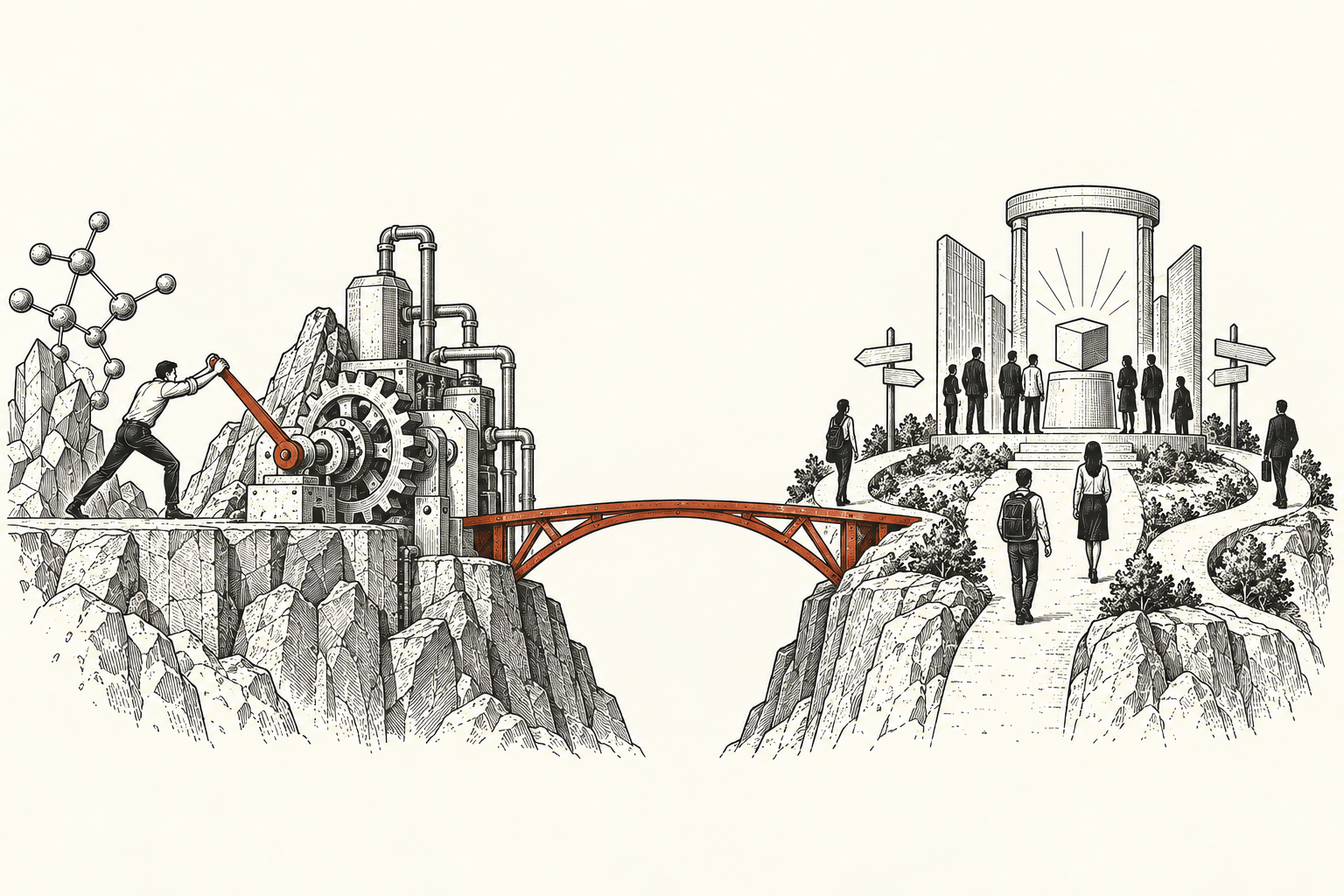
The bridge between the frontiers
The most important company may not own the original discovery or the final customer relationship. It may own the bridge that makes the capability adoptable.
The bridge can include:
• Integration into the buyer's system.
• Packaging and calibration.
• Qualification and certification.
• Manufacturing process and yield.
• Workflow design.
• Service and maintenance.
• Financing, warranty and risk allocation.
• Data that improves performance in use.
• Distribution into a trusted channel.
These activities are sometimes treated as implementation around the “real” technology. I think that understates them.
The bridge converts a scientific possibility into a dependable state change. It also determines who holds the evidence, interface and customer trust through which value can be captured.
A company that invents the capability but gives away the bridge may create enormous value and retain little of it. A company that owns the bridge can become powerful even when the underlying science originates elsewhere.
This is not an argument for outsourcing research or vertically integrating everything. It is an argument for knowing where translation occurs and who controls it.
The bridge is where the frontiers talk to each other
The relationship should not remain linear:
Distribution reveals what buyers will accept. Product use generates operating data. Failures change engineering priorities. Manufacturing teaches the limits of the process. Qualification makes hidden requirements visible. Customer economics decide which performance improvement actually matters.
The information should travel backwards:
When the loop works, the market frontier changes the nature frontier and the nature frontier creates new market possibilities.
This is why I am cautious when a research team says commercialisation begins after the technology is finished. The buyer's environment contains technical information the laboratory may not possess. I am equally cautious when a market-led team assumes any desired experience can be assembled from available technology. Reality may still contain the bottleneck.
Neither frontier has the final word alone.
Four positions, not two tribes
One way to locate a company is to ask whether capability uncertainty and market uncertainty are low or high.
| Capability uncertainty | Market uncertainty | Typical situation |
|---|---|---|
| Low | Low | A known product in an understood market; advantage often comes from execution and economics. |
| Low | High | The product can be built, but attention, behaviour, trust or distribution remains uncertain. |
| High | Low | The buyer's need is clear, but the required capability is not yet dependable. |
| High | High | Both the technology and the path to adoption remain unresolved. |
The table describes a moment, not an identity.
A company should move. Technical work reduces capability uncertainty. Customer work reduces market uncertainty. The bridge reduces the cost and risk of moving from one to the other.
The dangerous mistake is using evidence from one axis to claim progress on the other. A strong technical result does not prove willingness to pay. Customer enthusiasm does not prove the system can meet the requirement. Funding can extend the experiment without resolving either.
Progress has to be named precisely.
Neither frontier is morally superior
I want to be explicit about this because deeptech writing can become self-congratulatory.
Making nature yield is not intrinsically nobler than understanding human choice. Distribution is not the superficial work that happens after “real innovation.” A product capable of reaching millions of people, earning trust and changing behaviour may solve a problem as difficult as many technical challenges.
The distinction is useful only if it improves decisions.
It should tell a founder which uncertainty deserves the next experiment, which talent the company lacks, what evidence an investor should request and where a moat might accumulate.
If it becomes a hierarchy of founder virtue, it has failed.
What would weaken this framework
The Two Frontiers would be less useful if companies could not identify a dominant uncertainty even at a specific moment, or if the distinction produced no change in resource allocation.
It would also fail if the bridge were only administrative work that never created control, learning or value. In some markets that may be true: integration can be standardised, qualification can travel and distribution can be purchased. The company should not romanticise the middle when complementary assets are readily available.
The framework earns its place only when it helps the team locate a scarce constraint and act differently because of it.
Questions I now ask
1. What must become technically possible or dependable for the outcome to exist?
2. Which person or institution must choose, permit or pay?
3. Is the dominant uncertainty currently capability, market or translation between them?
4. What has become abundant, and where has scarcity moved?
5. Which evidence would reduce capability uncertainty?
6. Which evidence would reduce market uncertainty?
7. Who controls the integration, qualification and customer interface between the two?
8. Does learning from use travel back into research and product decisions?
9. Is the company confusing technical admiration with demand—or customer enthusiasm with feasibility?
10. What will still be scarce if the underlying technology becomes widely available?
The two frontiers explain where value can begin. They do not explain why a better future replaces the present.
Even when the outcome is valuable, the capability works and a buyer cares, an old system may remain rationally difficult to change.
That system is Goliath.