I initially understood the gap in deeptech as a funding problem.
There was money for research. There was money for large assets and visible growth. Between them sat a long, expensive period in which a prototype had to become a product. The obvious conclusion was that the ecosystem needed more patient capital.
I still believe the capital gap is real. But I now think it is only half of the problem.
The deeper gap is an acceptance gap.
A prototype must be integrated, tested in the relevant environment, qualified, manufactured, supported and accepted by a buyer who is accountable for the consequences. Scientific risk turns into product risk, operational risk, procurement risk and financing risk. The company can be technically correct and still fail at any one of these transitions.
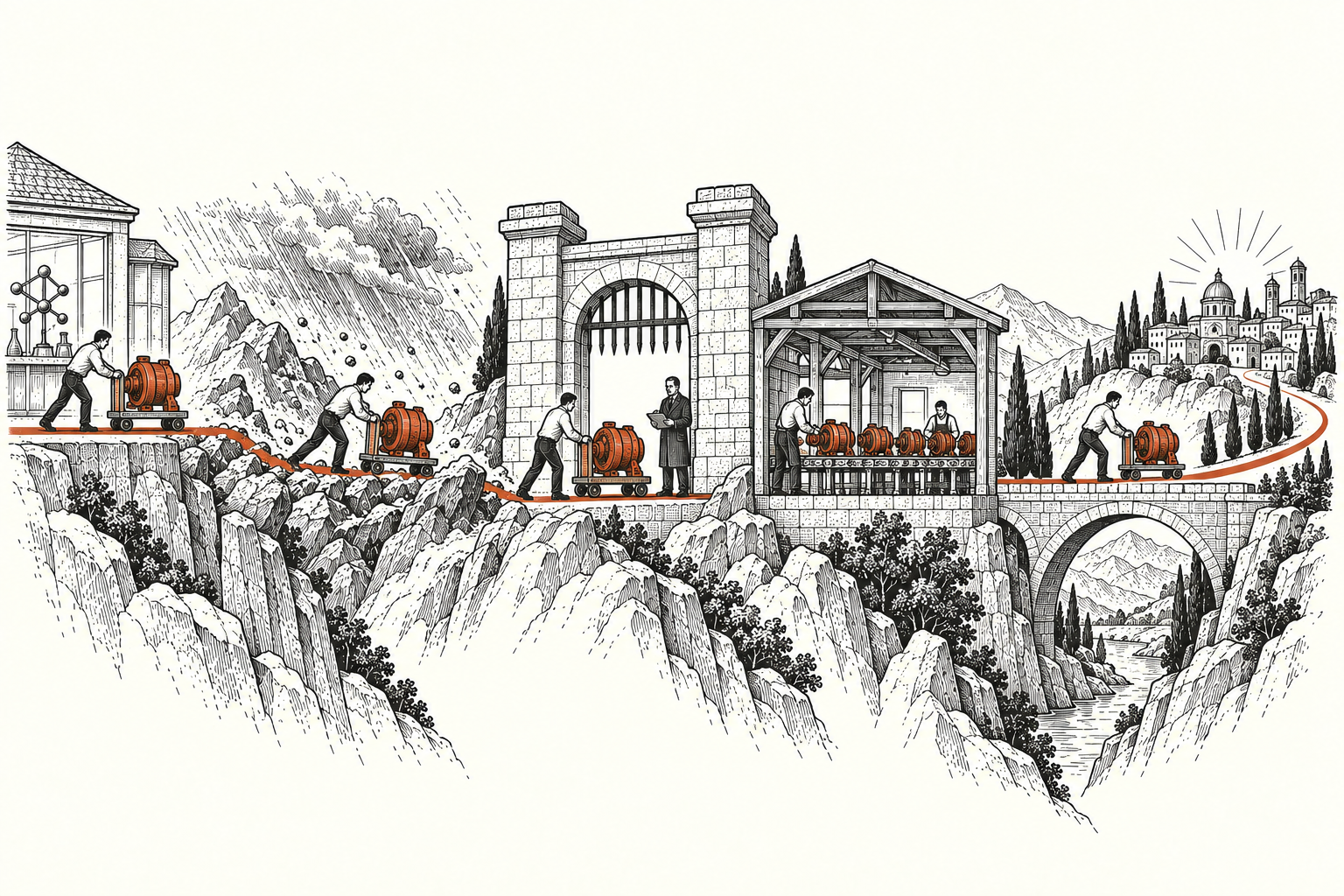
I call this period the difficult middle.
The name can make it sound like dead space between invention and scale. It is not. It is a distinct layer of value creation in which a company either accumulates an irreplaceable history or dissolves into pilots and project work.
Trust has to travel
In low-consequence products, a buyer can often verify the promise quickly. Try the application, dislike it and leave.
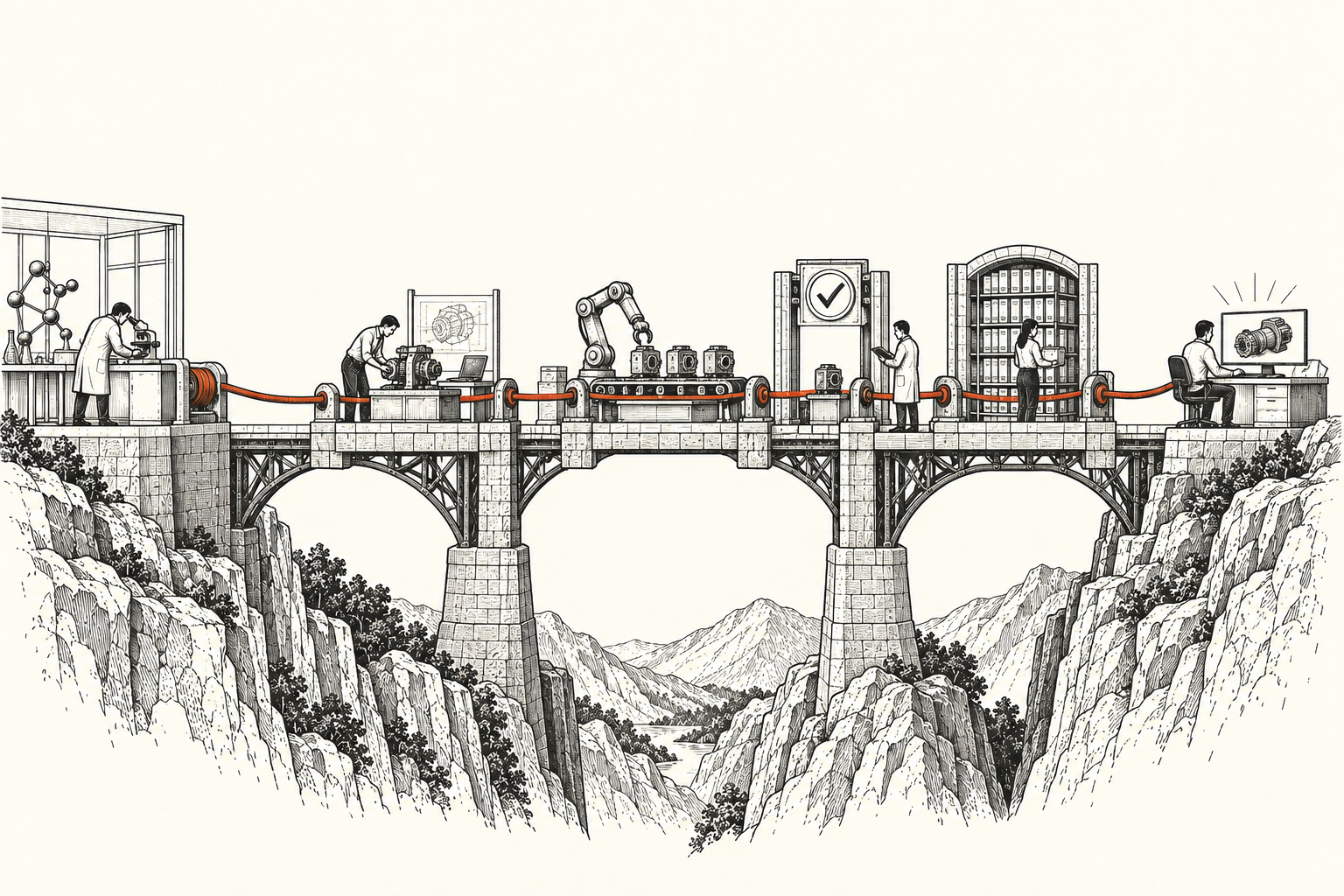
In deeptech, direct verification is delayed, expensive or impossible for most participants. The investor may not be able to reproduce the experiment. The procurement officer may not understand every failure mode. The regulator cannot personally observe every batch. The customer acts through evidence carried by papers, test reports, quality systems, certifications, field data and the behaviour of the company when something goes wrong.
Trust therefore has to survive a chain of handoffs:
At every handoff, a caveat can disappear and a controlled result can be promoted into a broader claim.
The complete product includes the trust system that lets evidence travel without the inventor standing beside it. Documentation, traceability, service, incident response and honest limits are not administration around the product. In a high-consequence market, they are part of what the buyer is buying.
A prototype and a product live in different worlds
A prototype succeeds in an environment designed to help it succeed.
The team understands the assumptions. The test conditions are known. The operator may be one of the people who built it. Unexpected behaviour becomes a problem to investigate.
A product enters an environment that owes it nothing.
The operator may not understand the underlying technology. The product has to work alongside equipment it did not choose. Maintenance may be delayed. Inputs vary. Weather changes. Users improvise. Procurement documentation matters. Service response matters. A failure that creates an interesting research question for the founder can create downtime, safety risk or career consequences for the buyer.
This is why “it works” is one of the most dangerous sentences in deeptech.
It normally means the technology worked under a particular set of conditions. The commercial question is whether it works under the conditions that govern the buyer's decision.
The Acceptance Ladder
I use five gates to separate different kinds of progress.
2. Relevant environment
3. Qualification
4. Repeatability
5. Economics
The ladder is not a universal certification system. Different industries use different readiness levels, standards and procurement processes. Its purpose is simpler: to prevent evidence at one stage from being narrated as if the next stage has already been passed.
Physics: demonstrate that the underlying effect works.
Each gate asks for different evidence. Passing one does not establish the next.
Gate 1 Physics
The first question is whether the underlying phenomenon works reproducibly.
Can the molecule produce the intended biological effect? Can the material reach the claimed property? Can the sensor detect the signal? Can the algorithm perform on an appropriate test set? Can the propulsion system generate the required thrust?
At this stage, the company is establishing that the claim is real enough to continue.
Physics proof may still depend on carefully controlled conditions, expert operators, selected inputs or equipment unsuitable for production. That does not diminish the achievement. It defines it accurately.
The common mistake is to translate scientific feasibility directly into a commercial product story.
Gate 2 Relevant environment
The second question is whether the capability survives contact with the environment in which it must operate.
Relevant does not necessarily mean the final customer's full deployment. It means the test contains the conditions most likely to break the claim.
For different products, that might include:
• Temperature, vibration, radiation or contamination.
• Real biological samples rather than idealised laboratory material.
• Variable feedstock rather than purified inputs.
• Network denial, interference or adversarial conditions.
• Untrained users.
• Integration with existing software and equipment.
• Continuous operation rather than a short demonstration.
The relevant environment reveals the difference between a phenomenon and a system.
A product may preserve its core technical advantage and still fail because calibration is unstable, interfaces are brittle, false positives are unacceptable, service requirements are excessive or surrounding components cannot tolerate the operating conditions.
Gate 3 Qualification
The third question is whether the person or institution with authority to say yes accepts the evidence.
This is where founders can underestimate the difference between validation and acceptance.
The company may have excellent data. The buyer may believe the data. But if the product has not passed the standard, audit, trial, design-in, test protocol or procurement process that governs the decision, the buyer may remain unable to purchase it.
Qualification is not merely a technical event. It is institutional translation.
The startup must understand:
• Who defines the test?
• Who performs or witnesses it?
• What documentation is required?
• Which failure thresholds matter?
• Can evidence from one buyer transfer to another?
• How long does the decision take?
• What happens after the product changes?
The authority that accepts the proof is as important as the proof itself.
Gate 4 Repeatability
The fourth question is whether success can be reproduced without extraordinary effort.
One qualified product does not establish a repeatable company.
Can the company manufacture again at the required yield? Can a second installation be completed without the founders personally solving every problem? Can service be delivered within the promised economics? Does performance remain stable across customers, operators and batches? Does the buyer reorder?
Repeatability is where hidden project work becomes visible.
A company may report several customers while effectively building a new product for each one. Revenue can grow while the operating system becomes more fragile. Customisation is not inherently bad, particularly in early markets, but the company needs to know what is becoming reusable.
The test is whether every deployment makes the next one cheaper, faster or more probable.
Gate 5 Economics
The final question is whether the complete system creates and captures attractive economics.
The laboratory cost is not the delivered cost. The bill of materials is not the cost of ownership. Gross margin before installation, warranty, working capital and field service may describe a different business from the one the company actually operates.
At this gate, the company must include:
• Manufacturing yield and scrap.
• Integration and installation.
• Quality systems and qualification maintenance.
• Warranty and failure costs.
• Service and customer support.
• Working capital and inventory.
• Channel or partner economics.
• Financing required by the buyer.
• The value captured after complementary providers are paid.
Economics determines whether a successful technology becomes a scalable company, a project business, an asset-financing problem or an important capability that belongs inside a different organisation.
Do not promote evidence prematurely
The most common analytical error is upgrading one step in the ladder into the next.
A paper becomes a product.
A laboratory prototype becomes field performance.
A field demonstration becomes qualification.
A qualified unit becomes repeat demand.
Revenue becomes attractive economics.
The incentives to do this are understandable. Founders need to raise capital. Investors want evidence of progress. Governments want programme success. Journalists need legible milestones. Each audience compresses the story.
But the compression can become dangerous when it changes the decision being made.
The solution is not cynicism. It is precision.
For every claim, ask:
1. What exactly was tested?
2. Under which conditions?
3. Who accepted the result?
4. Which next decision did the evidence unlock?
5. What remains unproved?
That allows genuine progress to be recognised without pretending it is something else.
Acceptance changes economic value
Qualification and field evidence are often described as delays between technology and revenue. I think this misses their economic function.
A buyer values an outcome partly according to the probability that it will be delivered.
The economics of trust
- Expected buyer value
- Probability of dependable delivery
- Value of the outcome
- Cost of adoption
- Expected cost of failure
A mental model, not a precise pricing formula. Confidence changes what the same outcome is worth to a buyer.
A new technical claim may promise a large outcome while carrying a low perceived probability of dependable delivery. Relevant-environment evidence raises confidence. Qualification creates institutional permission. Repeatability lowers the expected burden of adoption. Service history reduces the expected cost of failure.
The company may not have changed the theoretical maximum performance. It has changed the buyer's rational willingness to act.
This is why trust is not a soft layer added after the engineering. In high-consequence markets, trust changes expected value.
Failure can earn trust if it remains legible
Deeptech will fail in public and private. Batches drift. Pilots expose unmodelled conditions. Timelines move. A team that tries to appear infallible eventually makes the evidence less trustworthy.
A failed attempt can still strengthen the company when it states the claim in advance, uses a test capable of changing the decision, records the conditions, preserves the inconvenient result and alters what happens next. The failure becomes a receipt for learning.
The opposite is not failure but illegibility: changing the definition of success after seeing the result, presenting a controlled demonstration as field proof, hiding manual intervention behind the word automation or allowing a caveat to disappear before the customer sees it.
Customers and regulators know a new technology may fail. What they cannot safely tolerate is a company that makes failure impossible to inspect.
Integrity in the difficult middle is therefore operational. It appears in test protocols, traceability, change control, incident reporting and the permission to stop. The company becomes easier to trust because it has made itself easier to examine.
The accumulated right to be trusted
The difficult middle can therefore create assets that do not exist at the prototype stage.
• Flight history behind a propulsion or space subsystem.
• Package, test and software knowledge behind a semiconductor design-in.
• False-positive and field-performance history behind a sensor.
• Uptime and intervention data behind an industrial robot.
• Application data and qualification history behind a biological product.
• Yield and process knowledge behind an advanced material.
These assets are difficult to copy because they are earned inside operating environments, customer relationships and institutional processes that cannot be reproduced on demand.
The resulting moat is not the patent alone. It is the accumulated right to be trusted.
That right is never absolute. A serious failure can damage it. A new operating environment may require new evidence. A change in product architecture can reopen qualification. But accumulated trust can make the company the lower-risk choice even when competing technologies appear comparable on paper.
Crossing is not owning
A company can cross the difficult middle without owning it.
It may perform qualification work that belongs entirely to one customer. It may generate field data the integrator controls. It may manufacture successfully while the process learning resides with a supplier. It may build a complete deployment but remain unable to transfer the evidence to another buyer.
This is why the strategic question from the previous chapter remains essential:
What will the company own when the buyer says yes?
The answer may be:
• A qualified complete product.
• A reusable manufacturing process.
• A dataset that improves performance.
• An interface embedded in the system.
• A service network.
• A reference design.
• A procurement position.
• A product family made easier by the first acceptance.
If none of the evidence travels, the company may be crossing the middle repeatedly rather than accumulating an advantage.
The first buyer is part of the product
The first buyer does more than produce revenue.
The buyer defines what evidence matters, exposes the product to relevant conditions and may provide the first credible signal to the next buyer. A poorly chosen design partner can pull the company into bespoke requirements that do not transfer. A well-chosen one can help create a qualification record and product architecture that travels.
I would therefore ask whether the first buyer has:
• A problem urgent enough to tolerate early friction.
• The budget and authority to act.
• An operating environment that tests the important failure modes.
• A path from trial to real procurement.
• Requirements representative enough to support a broader product.
• Incentives compatible with the startup retaining reusable knowledge.
The first buyer is not simply a logo. It is part of the company's learning and acceptance architecture.
The middle needs different capital
The difficult middle is expensive because the proof changes form as the company advances.
Research capital may establish physics. Venture capital may finance product integration and a decisive technical experiment. Strategic or customer capital may support qualification. Asset or project finance may be more appropriate for deployment infrastructure. Growth equity may expand a repeatable system.
Using ordinary venture equity to finance every risk can leave the company over-diluted or undercapitalised. Using grant capital for work that requires urgent commercial iteration can slow the company. Using customer capital too early can trap it in bespoke product development.
The acceptance ladder therefore becomes a capital map as well as a product map.
The full financing logic comes later. For now, the principle is enough:
Each gate produces a different kind of evidence, and different capital is suited to buying it.
Questions I now ask
1. Which acceptance gate has genuinely been crossed?
2. What evidence supports that claim?
3. Under which operating conditions was it produced?
4. Who has the authority to accept the evidence?
5. What decision did the evidence unlock?
6. What remains unproved at the next gate?
7. Does the first buyer create transferable evidence or bespoke work?
8. Which data, process knowledge or qualification history remains inside the company?
9. Does each deployment make the next cheaper, faster or more probable?
10. What capital is appropriate for the next proof?
The difficult middle is not the delay between innovation and value. It is where technical possibility becomes dependable enough to buy.
The company that merely passes through may reach a market.
The company that owns what it learns along the way may build a moat.