I began this book because too many different signals were landing in the same bucket.
A paper, patent, prototype, grant, funding round, pilot, memorandum, order, delivery and repeat purchase could all be presented as evidence that a deeptech sector was “taking off.” Each signal contained information. They did not contain the same information.
Once they were mixed together, almost any story could sound inevitable.
I do not want to end with another prediction about how large Indian deeptech will become by 2030. Predictions are useful when they expose assumptions. They are less useful when size itself becomes the argument.
I want to end with receipts.
By a receipt, I mean evidence that an important state has actually changed, accepted by an actor whose behaviour matters.
A technical result can be a receipt for physics. It is not a receipt for demand.
A qualification can be a receipt for acceptance. It is not a receipt for repeatable production.
A purchase order can be a receipt for commercial intent. It is not a receipt for delivery, acceptance, margin or repeat demand.
A second order after use says something the first order cannot.
The purpose of receipts is not to make progress harder to celebrate. It is to make progress possible to understand.
The receipt must match the claim
Every large claim implies a particular kind of evidence.
If the claim is that the science works, I want reproducible technical results.
If the claim is that the product works in the real environment, I want field or flight data under the conditions that matter.
If the claim is that a buyer accepts it, I want the relevant authority's qualification, design-in, acceptance record or purchase decision.
If the claim is that the company can scale, I want stable yield, traceability, delivery performance and a second batch that resembles the first.
If the claim is that customers receive value, I want evidence at the customer's boundary: uptime, throughput, cost, quality, energy saved, mission effectiveness or another contracted outcome.
If the claim is that the company has a moat, I want evidence that learning compounds and that the company retains the layer through which it captures value.
The strongest receipt changes behaviour. A buyer pays, a regulator permits, an engineer designs in, a lender finances, a prime standardises, a customer reorders or a new market accepts prior proof.
Attention alone does not do this.
A hierarchy of receipts
I find it useful to arrange evidence in seven levels.
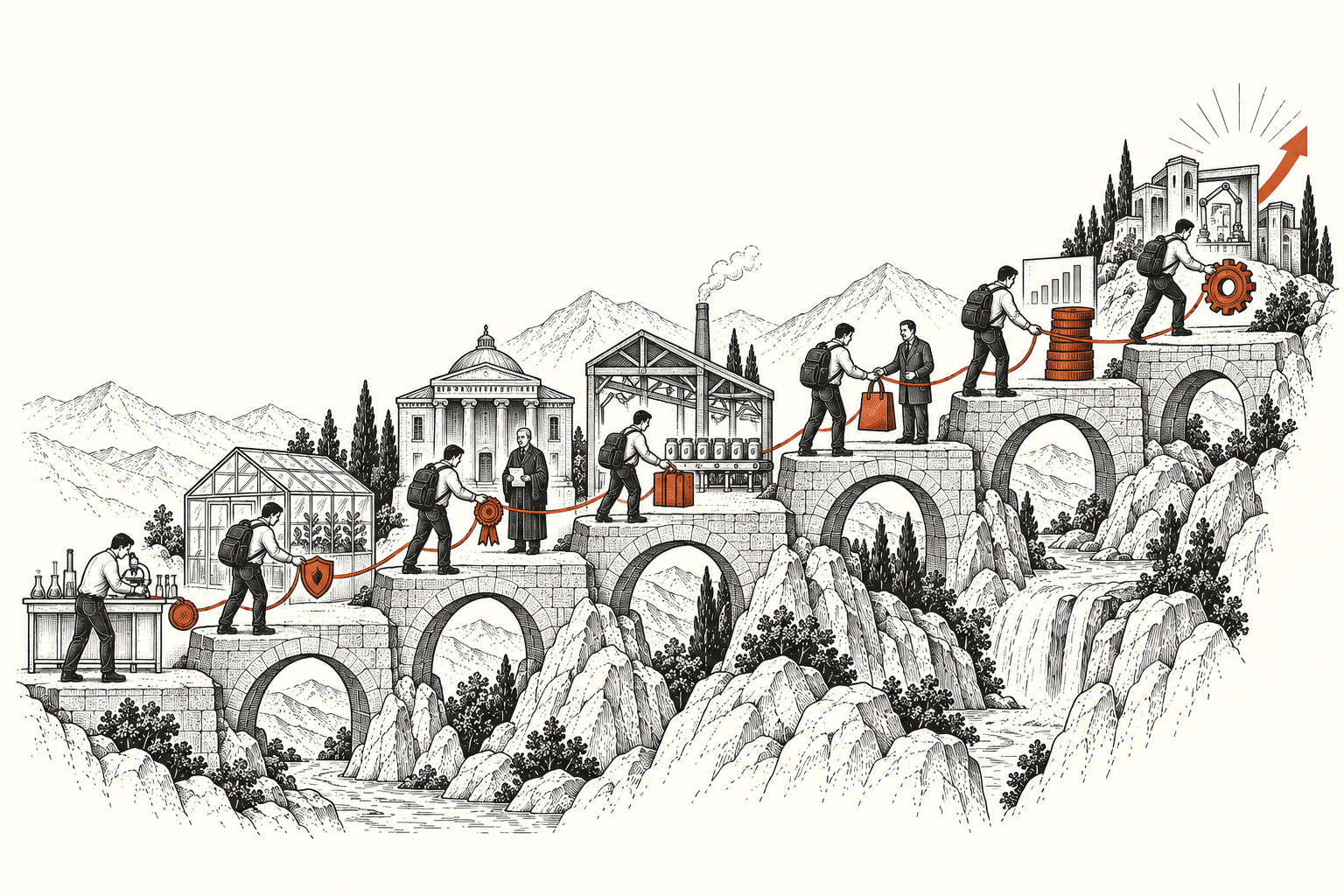
Technical receipt
The underlying claim works reproducibly.
Examples include an independently verified result, repeated experimental performance, a successful tape-out or a functional integrated prototype.
This is necessary evidence. It should be celebrated. It does not establish a complete business.
Relevant-environment receipt
The capability survives the conditions that determine usefulness.
This might be a field trial, flight, industrial run, clinically relevant setting, environmental test or operation against representative interference and failure modes.
The relevant environment removes the comfort of the demonstration.
Acceptance receipt
The authority who can change the purchase decision recognises the evidence.
This might be certification, qualification, a design-in, validated performance by the buyer, security clearance or formal acceptance after delivery.
The key question is not whether the result looks impressive. It is whether the right gatekeeper accepts it.
Production receipt
The company can make or deploy the product again with controlled quality.
I would look for a frozen design, stable yield, traceability, qualified suppliers, documented processes, delivery consistency and service capability.
One heroic unit proves possibility. A controlled batch begins to prove a company.
Demand receipt
A buyer purchases, uses and then chooses again.
The first contract may contain experimentation, strategic signalling or subsidy. A follow-on order after operating experience is much stronger evidence. A second independent customer is stronger in a different way: it suggests the product is not entirely captive to the first relationship.
Economic receipt
The system creates attractive economics for the customer and for the company.
This means more than revenue. It includes gross margin, cost of deployment, working capital, warranty, service burden, sales cycle, utilisation and the capital required to produce each additional unit of growth.
A product can be technically successful and commercially ruinous. The economic receipt prevents the two from being confused.
Compounding receipt
The first product makes the next product, customer or market easier.
Qualification travels. Manufacturing improves. Deployment generates proprietary data. Customer access lowers distribution cost. Suppliers become more reliable. A component wins additional design-ins. A platform supports adjacent products without restarting from zero.
This is the receipt that the company is becoming more than a collection of difficult projects.
Five receipts that changed the category
The hierarchy becomes clearer when we follow real cases. In each one, the decisive moment was not the original idea or the loudest announcement. It was the receipt that caused another actor to behave differently.
NASA COTS and SpaceX when a demonstration became a service
NASA began the Commercial Orbital Transportation Services programme in 2006 to help private companies develop and demonstrate cargo transportation capability to low-Earth orbit and the International Space Station. The structure mattered: financial and technical support was tied to milestones rather than treated as proof that a vehicle already worked.
The decisive receipt arrived in May 2012, when SpaceX's Dragon became the first commercial spacecraft to deliver cargo to the station. That was more than a launch video or an isolated technical success. NASA had participated in the verification, the spacecraft had operated in the relevant environment and the customer with authority to accept the capability had accepted it.
The next receipt followed quickly. In October 2012, SpaceX launched the first contracted cargo-resupply mission under NASA's Commercial Resupply Services contract.
The sequence matters:
→ relevant-environment demonstration
→ customer acceptance
→ contracted repeat service
The first mission proved that the new system could perform. The service contract proved that the buyer was willing to reorganise procurement around it.
ASML and EUV when a scientific possibility entered the fab
Extreme-ultraviolet lithography is an antidote to the mythology of the lone breakthrough.
The path from early EUV research to high-volume chip manufacturing required decades of work across light sources, optics, masks, stages, vacuum systems, contamination control, metrology, software and suppliers. ASML acted as the system architect, but the capability existed through a global network that included ZEISS, TRUMPF, Cymer, research institutes and semiconductor customers.
A prototype that printed an image was a physics receipt. A pre-production system shipped to a customer was a relevant-environment receipt. Neither was yet proof that a fab could depend on EUV economically.
The category changed when the systems entered high-volume manufacturing. ASML reported that EUV systems entered high-volume manufacturing fabs in 2019 and marked its hundredth EUV-system shipment at the beginning of 2020.
Those receipts contained years of less visible evidence: source power, availability, throughput, defect control, service response and the willingness of chipmakers to place EUV on production roadmaps. The triumph was not only making 13.5-nanometre light. It was making an extraordinary physical system dependable enough to become ordinary inside a factory.
NVIDIA CUDA when hardware created a developer economy
NVIDIA introduced CUDA in 2006 so programmers could use the parallel-processing capability of GPUs without treating them only as graphics devices.
The launch was a technical and product receipt. The stronger receipt was compounding adoption.
Developers ported scientific and engineering applications. NVIDIA kept building compilers, libraries, profiling tools and hardware that supported the same computing model. More useful applications increased demand for compatible GPUs; a larger installed base made CUDA more attractive to developers; a larger developer base justified more investment in tools and silicon.
→ programming model
→ libraries and tools
→ developers and applications
→ larger installed base
→ more investment in capability
The moat was not a benchmark frozen in time. It was the reinforcing system around the benchmark.
This is why a software layer can be central to a deeptech company. CUDA translated a physical architecture into capability other people could use, then allowed their work to strengthen the platform.
Apple from iPod to iPhone when one product left capability behind
The iPhone did not begin with the iPhone.
The iPod and iTunes system taught Apple how to connect hardware, software, content, synchronisation, industrial design and retail into a complete activity. The company learned to ship small consumer devices at scale, manage a digital-media relationship and make a technically complicated system feel coherent to a non-technical user.
Those assets did not automatically guarantee the iPhone. Telephony, touch interfaces, mobile silicon, battery life, carrier relationships and a new software platform created further constraints. But the earlier product left behind more than revenue.
It left organisational capability.
The receipt was visible in what the next product could assume. Apple did not need to learn integrated consumer hardware, desktop software, retail demonstration and digital distribution from zero. The iPod had created a base from which the iPhone could combine research, technology, product and distribution at a higher level.
This is the compounding receipt in its cleanest form: the product sold today changes what the company is capable of attempting tomorrow.
MRNA and lipid nanoparticles when a platform crossed different gates
The success of mRNA vaccines against COVID-19 is sometimes narrated as a sudden response to a sudden crisis. The receipts reveal a longer chain.
Researchers first had to show that modified messenger RNA could carry an instruction without provoking an unusable immune response. Delivery systems, including lipid nanoparticles, had to protect the RNA and help it enter cells. Manufacturing and analytical methods had to become repeatable. Clinical trials had to establish safety and efficacy. Regulators had to accept the evidence. Production and distribution then had to operate at pandemic scale.
The COVID-19 vaccines were not merely a scientific receipt. They were clinical, regulatory, production and demand receipts arriving in a compressed period for a platform built over decades.
The next test for the platform is oncology. An individualized neoantigen therapy has to turn a patient's tumour information into a tailored mRNA treatment and do so quickly, reproducibly and with clinical benefit.
On 19 August 2026, Merck and Moderna announced that the Phase 3 INTerpath-001 trial of intismeran autogene in combination with KEYTRUDA met its recurrence-free-survival primary endpoint and a key distant-metastasis-free-survival endpoint in patients with completely resected high-risk melanoma. The companies said they planned to present the data and engage regulators on filings.
That is a major clinical receipt. It is not yet the same as regulatory approval, routine manufacturing, reimbursement or broad patient access. The category of the claim has advanced; it has not reached the final gate.
This is exactly why the receipt vocabulary matters. It lets us recognise a genuine state change without borrowing evidence from a future that has not yet arrived.
What I would want to see by 2030
The sectors in the India report require different domain evidence. The underlying tests remain remarkably consistent.
Defence and mission systems
I would want to see Indian-designed systems delivered, accepted in operationally relevant conditions and purchased again.
Development awards, challenge wins and successful demonstrations would not be enough. The harder receipts are production clearance, stable configuration, delivery, acceptance, field performance, service readiness, follow-on procurement and deployment on a second platform or with a second user.
For enabling components, I would want to see them designed into repeat systems rather than substituted after a pilot.
Space
Launch and in-orbit demonstrations are meaningful receipts. They should be described accurately.
The next receipts are customer-flown heritage, qualified lifetime, repeat production, repeat orders and use by customers who did not sponsor the initial development. A successful mission proves something extraordinary; it does not by itself prove manufacturing cadence or durable demand.
Semiconductors, photonics and sensors
The sequence matters:
→ tape-out or fabricated device
→ packaging and test
→ qualification
→ design-in
→ repeat production
→ multiple customers or platforms
Each arrow represents a place where value can disappear.
I would count Indian-owned products in repeat production and difficult-to-reverse design-ins as receipts. I would also look at who owns the architecture, interface, process knowledge and customer relationship. Local activity is not the same as local power.
Robotics and industrial systems
The receipt is not the quality of the demonstration video.
It is the workcell or system running against the buyer's operating measure: throughput, intervention rate, uptime, safety, changeover time, defect rate and total cost. I would want to see a second installation that requires less engineering effort than the first and a buyer willing to expand after use.
If every deployment remains a new integration project, the market may be real while the company remains incomplete.
Energy, storage and industrial decarbonisation
I would want systems qualified in the operating environment, backed by credible warranties and producing buyer-legible economics.
For storage, this may include degradation and health data, realised availability, safety, warranty performance, residual value and the ability of lenders or customers to finance repeat deployments.
For industrial heat, materials or decarbonisation systems, the receipts include durability, process compatibility, measurement and verification, contracted savings or offtake, and performance across more than one site.
Project announcements and installed capacity can conceal who bears technical risk and whether the corporate return is attractive. The financing structure is part of the receipt.
Biomanufacturing
The receipt is not only an interesting biological pathway or laboratory titre.
It is repeatable product quality across batches, qualified production, acceptable cost, reliable capacity, regulatory or customer acceptance where required, and repeat revenue. Qualified export revenue would be especially meaningful because it combines technical, quality, commercial and cross-border acceptance.
The process must work on Monday and again on Thursday, not once under ideal conditions.
Frontier instruments and enabling tools
For instruments, test systems and research tools, I would look for integration into real workflows, calibration and service capability, repeat use, reference customers and evidence that the tool shortens or improves a consequential decision.
The instrument becomes strategic when customers depend on its output, not when they merely admire its precision.
Company receipts and ecosystem receipts
Individual companies cannot produce every condition they need.
An ecosystem also has to show receipts.
At the company level, I would look for:
• Accepted products.
• Repeat production.
• Follow-on demand.
• Improving deployment economics.
• Retained ownership of the critical layer.
• Evidence that one product makes the next easier.
At the ecosystem level, I would look for:
• Test and qualification infrastructure whose results buyers recognise.
• Procurement that moves from development to acceptance and repeat ordering.
• Suppliers able to meet traceability, quality and volume requirements.
• Working capital and later-stage capital available after technical success.
• Project finance for deployments that no longer belong on venture balance sheets.
• Global customers buying Indian-owned products, processes and systems.
• Talent moving between research, manufacturing, product and markets without losing the underlying knowledge.
An ecosystem is not mature because it can start many companies. It is mature when good companies can cross the gates without having to invent the entire surrounding institution themselves.
Keep a receipt ledger
Narratives become slippery over time. A claim made during a funding announcement is remembered later as though it had already been delivered. A pilot becomes “commercial traction.” A programme ceiling becomes money received. A memorandum becomes an order.
I would keep a simple ledger for every important company or sector claim:
| Field | Question |
|---|---|
| Claim | What exactly is said to be true? |
| Date | When was the evidence first observed? |
| Source | Who reported it? |
| Authority | Who has the power to accept the proof? |
| Gate | Physics, environment, qualification, repeatability or economics? |
| Consideration | Did money, rights or obligations change hands? |
| Repeat | Has the result occurred again? |
| Buyer consequence | What behaviour changed? |
| Company consequence | What became easier, safer or more valuable? |
| Next disconfirming event | What evidence could weaken the claim? |
The ledger is deliberately unglamorous. That is its value.
It prevents the emotional force of a story from changing the category of the evidence.
The falsifiers matter more than the forecast
I can be wrong about the strength, timing or shape of India's deeptech opportunity.
By 2030, I would take the following patterns as serious evidence against the thesis in this book:
• Public programmes, startup counts and pilot activity rise without follow-on procurement or repeat commercial demand.
• Indian firms remain engineering vendors while product ownership, interfaces and distribution sit elsewhere.
• Components are demonstrated but fail to enter repeat production or durable design-ins.
• Mission systems win development support but do not achieve delivery, acceptance and second orders.
• Industrial deployments produce no buyer-published operating economics and remain dependent on continuous subsidy or corporate equity.
• Biomanufacturing and materials companies show laboratory progress but little qualified repeat revenue.
• Each customer requires a bespoke product, preventing qualification and manufacturing learning from travelling.
• Critical imported components or process dependencies repeatedly stop companies at scale.
• Technically successful companies fail because working capital, qualification infrastructure or deployment finance never develops.
• Growth consumes more integration effort, service cost and capital per customer rather than less.
None of these would imply that the underlying science was unimportant. They would imply that the bridge from capability to company power remained incomplete.
Falsifiability is not pessimism. It is how I prevent hope from impersonating analysis.
Receipts are also a form of respect
Deeptech founders are often told two contradictory stories.
One story romanticises them. Every breakthrough is world-changing; every strategic market is inevitable; patience will eventually be rewarded.
The other story compresses years of scientific and engineering work into a conventional revenue question before the relevant proof could reasonably exist.
Both can be intellectually lazy.
The receipt framework asks a harder but fairer question: what has this team actually made true, which uncertainty did that remove and what evidence should reasonably come next?
That allows us to recognise real technical progress without pretending the company has crossed gates it has not crossed. It also allows us to value qualification, manufacturing, documentation, field support and repeat delivery—the less visible work that turns invention into dependence.
Questions I now ask
1. What claim is being made, exactly?
2. Which kind of receipt would support that claim?
3. Who has accepted the evidence, and do they control the relevant decision?
4. Is this proof of physics, environment, qualification, production, demand, economics or compounding?
5. What changed in the buyer's behaviour?
6. Has the result repeated across a second batch, order, site, platform or customer?
7. Who owns the learning, interface and qualification history?
8. Does growth require less uncertainty and less custom effort, or merely more capital?
9. What would falsify the story before the next financing round?
10. Which receipt should exist by 2030 if the thesis is true?
The deepest moat in this book is not mystery.
It is accumulated evidence.
A company crosses the Difficult Middle one accepted result at a time. The prototype works. The product survives the real environment. The authority qualifies it. Production repeats. The buyer returns. The economics improve. The first product leaves behind the capability to build the next.
Eventually, what once looked like a risky technical claim becomes part of how the buyer operates.
That is when activity becomes capability, a forecast becomes evidence and the thesis finally produces receipts.